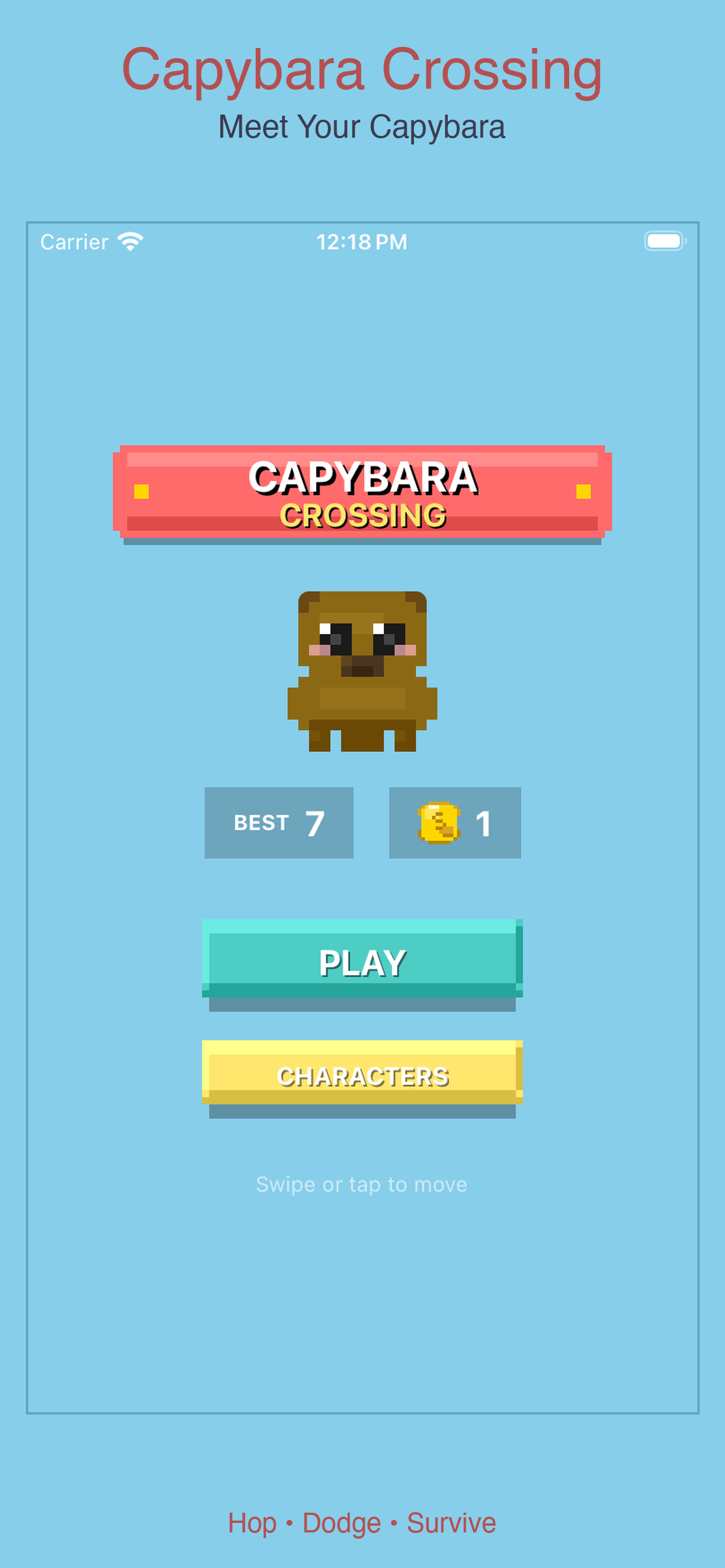
After a long run of utility apps, I wanted to make something that was just fun. Something my niece could pick up in two seconds with no tutorial and no explanation. The “hop across endless lanes of traffic” formula is a classic for a reason, so I dropped a capybara into it and built Capybara Crossing: hop across roads, train tracks, and rivers, grab coins, try not to die. It turned out that a casual game is a completely different discipline from a tool, and it taught me things the tools never did.
Why a casual game #
Utility apps solve a problem. Casual games create a feeling. Those are different design jobs, and I wanted reps in the second one. The bar is sneaky, too. The gameplay is simple, and simple has nowhere to hide. If the hop does not feel good, there is no feature list to distract from it and no settings screen to get lost in. The core loop is all you have, naked and exposed.
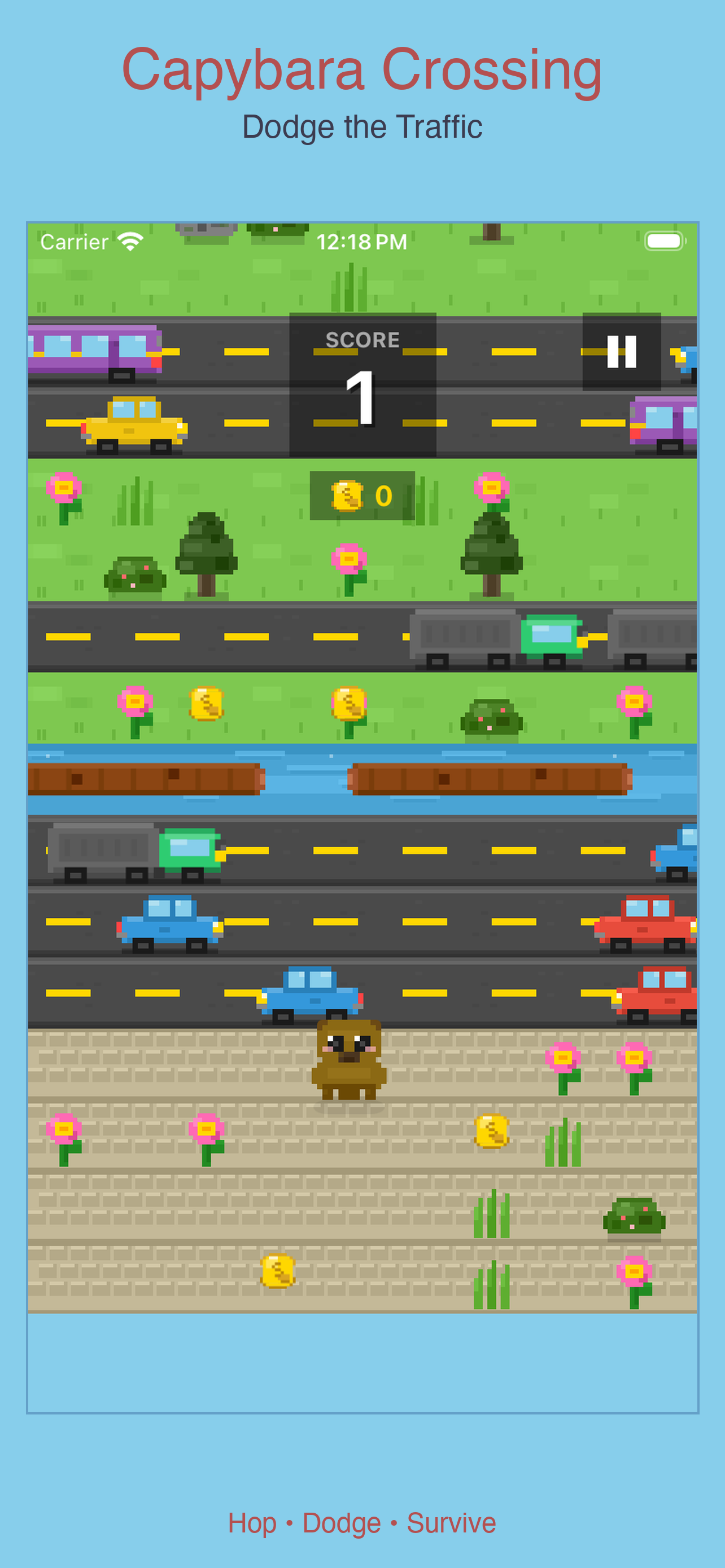
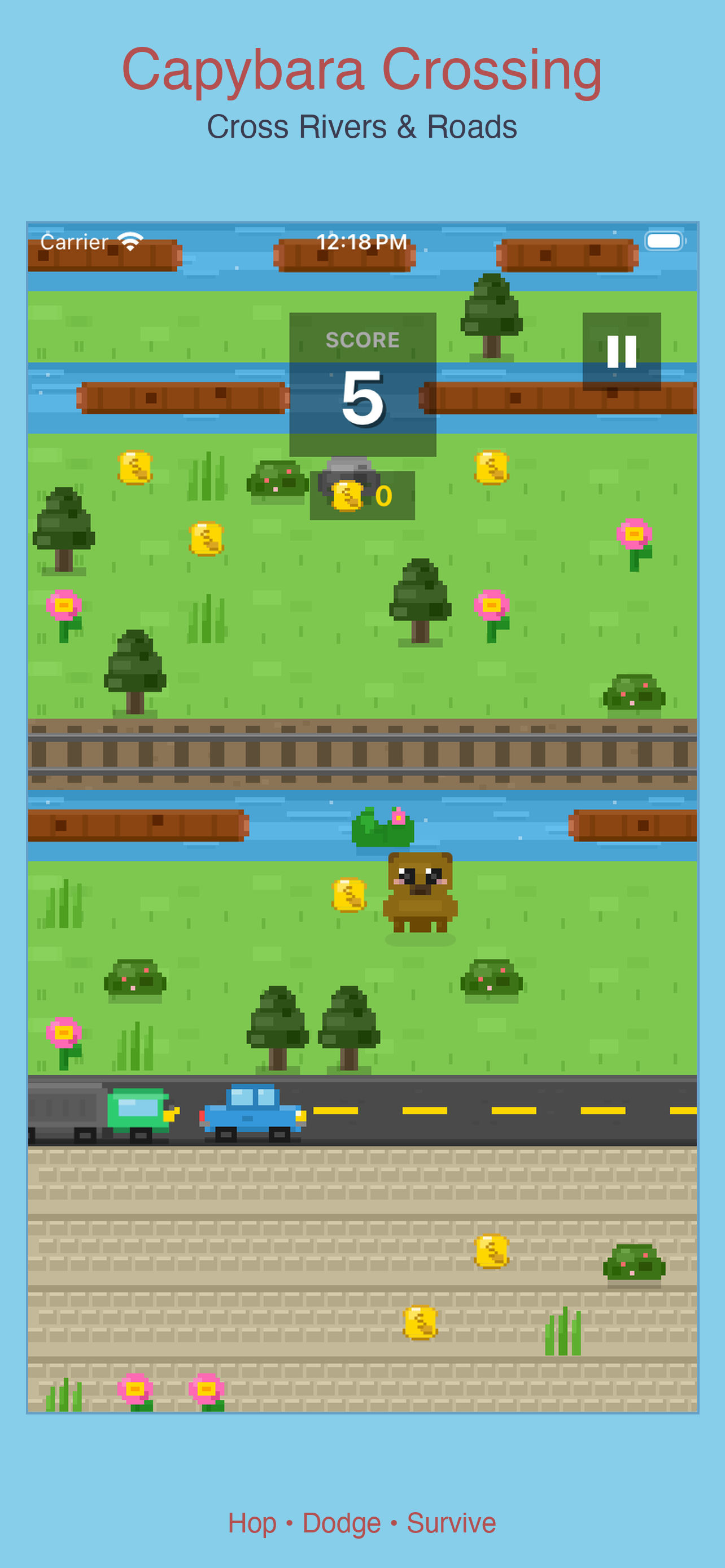
The pitch fits in a breath, which is the point. You are a capybara, the world is a wall of cars, trucks, buses, trains, and rivers, and you hop forward as far as you can. Cute character, instant understanding, one thumb. A five-year-old and a fifty-year-old both get it in the first second.
Feel is everything #
In a utility app, “it works” is the finish line. In a game, “it works” is the floor. Feel is the ceiling, and I poured a wildly disproportionate amount of time into things no spec sheet would ever list:
- The hop. Its timing, the little arc, the snap onto the next tile, the tiny squash on landing. That one animation decides most of whether the game feels good or cheap.
- Readability. You have to see instantly where it is safe to land. Lane spacing, hazard timing, and color all exist to make that obvious, because a death that feels unfair makes people quit, and a death that feels earned makes them tap retry.
- The difficulty ramp. Gentle enough to start, mean enough that “one more try” gets its hooks in you. The curve has to feel fair the whole way up.
You cannot spec your way to good feel. You build it, play it a hundred times, nudge a single number, and play it a hundred more. That loop is where most of the real work lives, and there is no way around it. This is also where the AI hit its ceiling, which I will come back to.
The eagle: killing the “just stand still” exploit #
Every endless hopper has the same flaw. Players figure out they can stop moving and sit there, perfectly safe, forever. All the tension drains out. My fix is a threat wired straight into the design: linger too long and an eagle drops out of the sky and carries you off. Keep moving or else.
Tiny mechanic, huge effect. It deletes the safe option, holds the tension steady, and quietly rewrites the game from “dodge hazards when you feel like it” into “always be moving, manage the danger as it comes.” The best game design is often a single rule that pushes players toward the behavior you want without a tutorial spelling it out. The eagle never explains itself. It teaches you once, and you never stand still again.
Coins, characters, and a reason to come back #
A high score gets someone to play once. Progression gets them to come back. The loop is small:
- Grab coins while you hop, so every run has a second point beyond distance.
- Spend them to unlock characters, six of them, including a Pirate, a Ninja, and a Space Capy.
Cosmetic unlocks are a great fit for a casual game. They hand players goals without piling on rules to memorize, and “I just want the Space Capy” turns out to be a surprisingly sticky reason to keep playing. Everything is earnable by playing rather than paying, which keeps the game fair and builds goodwill instead of resentment.
Where vibe coding helped, and where it quit on me #
AI assistance was great for the scaffolding: the core loop, procedural lane spawning, collision detection, the coin and save system, the unlock screens. It got me from nothing to a playable prototype fast, and fast is exactly what a fragile early game project needs, because the window where you abandon it is right at the start. Reaching “I can actually play this” quickly is what kept the whole thing alive.
What the AI could not do was tell me whether the game felt good. Tuning the hop, spacing hazards so they are hard but fair, pacing the difficulty so it pulls you forward instead of pushing you away, that is all taste and playtesting, and it stays human. An assistant hands you a working game. Only playing it, over and over, turns a working game into a fun one. That split between what the AI does and what you own is the same one I lean on everywhere.
What polish actually means #
The biggest surprise was how much the invisible details mattered. A casual game lives or dies on a hundred things no player could name: the exact beat before the eagle appears, the weight of a landing, the half-second of feedback after a coin, the way the camera leans forward. None of it shows up in a feature list, and all of it separates a game that feels cheap from one that feels good in the hand. That attention to feel is a muscle. Build it on a game, where feel is the only thing you have, and you start spotting the same missing polish everywhere else, in the tools you were sure were already finished.
What shipping it taught me #
- The first 30 seconds decide everything. Casual players judge fast. No fun first session, no second session. The opening has to land.
- Juice matters. The sounds, the little animations, the satisfying coin pop. That feedback is not decoration, it is the feel.
- Offline and free. No connection needed, progress saved locally, no paywall between the player and the fun. Friction is the enemy of casual.
- Constraints breed charm. One capybara and one clean mechanic beat the sprawling design I would never have finished. The limits made the game.
Building a game after a stack of tools was the best thing I did for my craft all year. It drags your attention onto feel, not just function, and that habit follows you home into everything else you make, including the serious apps where “it works” was quietly never quite enough, like my on-device AI chat app and private transcription app.